 Aljazeera
"Nuclear Weapon".. Governance in the Korean Union
The Korean issue remains a significant driver of ongoing discussions in the corridors of global strategic policy, as it is one of the precise levers for assessing the fate of security and geopolitical arrangements that may arise in the regional equation of East Asia as a whole. American politicians say that North Korea’s problem takes an increasingly extreme turn as time goes on, yet the American vision for resolving this crisis remains unclear to this day.
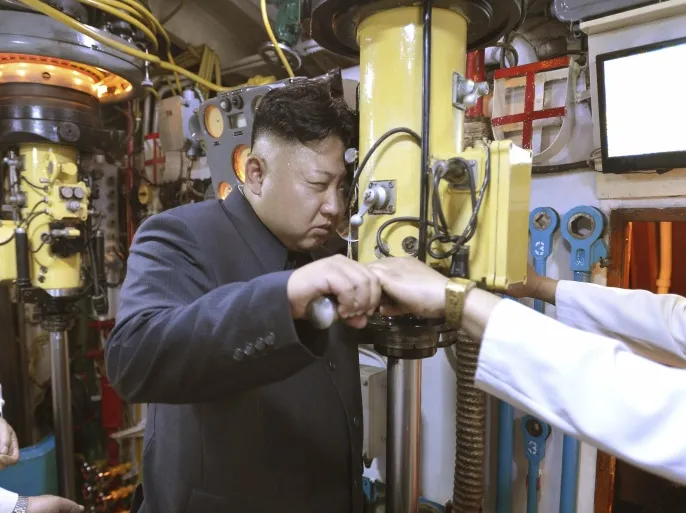
Realist scholars in America acknowledge that the policy of rejection and isolation has not achieved any successes in getting the North Korean regime to abandon its nuclear weapons program. Rather, the "strategic patience" approach adopted by the previous Obama administration did not tame Pyongyang; instead, it reinforced the Korean regime's historical tendency to irritate and challenge American policy. This is why many strategic thinkers in Washington face a major problem in understanding the contractual system of North Korea, while the maximum understanding of the North Korean problem lies in estimating the lifespan of the rigid regime in Pyongyang, the state it will reach if it opens up to the world, and the position its nuclear program holds in its survival strategy.
| The Trump administration appears resolute in punishing Kim Jong Un's regime, but it lacks conclusive evidence of Pyongyang's ability to withstand an external military strike. |
Chinese diplomacy tried to play a rational role between its neighbor North Korea and its partner the United States, but the documents that Beijing was waving did not satisfy the ruling regime's desires in North Korea. This is the logical basis for the Koreans' lack of alignment with Chinese mediation to resolve the crisis, and perhaps the alignment of China with the economic sanctions imposed by the United Nations on North Korea is sufficient to explain the failure of Chinese diplomacy on the nuclear issue. Therefore, the Koreans consider that nuclear weapons represent a strategic alternative for Chinese intervention as a paper in the North Korean regime's defense against the last resort.
In Washington's political elite circles, there is a widespread belief that betting on China's and Russia's ability to convince North Korea to abandon nuclear armament is a failure. If we look at the issue from the dialectical perspective that has dominated American policy over the past decades, it can be said that China and Russia do not appear to support the American position on the North Korean crisis in all its aspects, and Beijing and Moscow warned Washington during the crisis about a military slide that would lead to opening war fronts in the region. From here, we want to raise the question: In which direction are Moscow and Beijing's positions on North Korea moving?
There are serious strategic concerns stemming from the United States' tendency to formulate a new equation in East Asia that does not take into account Russia's and China's security needs, describing it as a framework for encircling Russia's strategic depth in Asia from one side, and containing Chinese influence in the same region, paving the way to impose a balance of power in Asia where the United States plays the role of the sole external balancer.
These security anxieties align with the common U.S. belief that a scenario of unifying the Korean Peninsula is inevitable, and in such a situation, strategic experts must deal with long-term planning regarding the position that unified Korea will occupy in Asia, which is a region that falls within the vital spheres of rising powers that influence global politics: "Japan, China, Russia," two of which possess nuclear arsenals, with a third country "Japan" raising concerns about its future status. Therefore, American motives for unifying Korea appear very strong. Moreover, the existence of a unified Korea would ensure its transformation into a major industrial and technological power in Asia.
| Possessing nuclear weapons would represent the last bargaining chip in the hands of leader Jong Un in the event of internal chaos, or loss of central control over the country as a result of attacks carried out by the United States. |
And if we take into account North Korea’s desire to control its sister country South Korea in order to bring it under the banner of the North Korean regime, the nuclear option would serve as the judge of what such an crisis would produce, especially if the United States intervenes. Thus the task appears very daunting, and within this context—an issue that echoes in American political circles—is the strategic ambiguity that surrounds intelligence and military assessments of North Korea’s “defensive and offensive” capabilities, and the behavior that this regime might adopt if attacked by the United States or South Korea.
For the Trump administration, which appears resolute in punishing Kim Jong‑Un’s regime, there is still, at this moment, a lack of conclusive evidence regarding Pyongyang’s ability to absorb an external military strike and its willingness to launch a retaliatory attack. The notion that North Korea lacks the capacity for a “second strike” remains under scrutiny by U.S. military strategy experts. The most important strategic lesson in containing North Korea is to neutralize the regime entirely, thereby ensuring that the United States can prevent it from launching violent strikes against American alliances and interests in South Korea, Japan, or on U.S. soil itself. Therefore, a swift and decisive defeat of North Korea will not be easily secured. If Pyongyang possesses a “nuclear deterrent,” it could change the strategic equation, and in any case, nuclear weapons could reduce the level of threats that North Korea might face in the event of a regional war.
This position assumes that possessing nuclear weapons would represent the final bargaining chip in the hands of leader Jong‑Un in the event of internal chaos or loss of centralized control due to U.S. attacks, and that the regime could achieve a ceasefire on terms acceptable to it by threatening nuclear escalation. Thus, the greatest problem with North Korea is that the United States does not want the cure to be worse than the disease itself, because it would not achieve regional peace in Asia and would lose ultimate confidence in the effectiveness of its strategic role in ensuring regional and global security. The lowest point is betting on the possibility of a sudden collapse of the regime under local environmental pressure, a probability that seems somewhat weak, not to mention the many burdens that arise from its heavy campaign, with the possibility that chaos could slide across the entire Korean Peninsula in an unfavorable manner.
Comments (0)
No comments yet. Be the first to comment.