 Aljazeera
Standardized Waves in Trump's Administration on Global Affairs
It is wrong to believe that the history of American global dominance begins with the defeat of communism in the Cold War, and it is truly ironic to find those who believe that the United States was waiting for the news of the Soviet Union's collapse to announce its new global system led by an individual. This is merely an assumption that does not align with realistic data.
Japan’s nuclear strike during World War II served as a stark warning against the United States’ tendency to dominate the global rules of the game. The intended purpose of using a nuclear weapon, as witnessed in Nagasaki and Hiroshima, was not merely to compel Japan to surrender, but to achieve a broader strategic objective. If the war had continued without nuclear weapons, Japan would have already capitulated. However, the logical implications of this horrific event extended beyond a single goal. That systematic deviation from the global policy framework led to confusion across all strategic affairs, resulting in structural imbalances in the power hierarchy on the world stage, and foreshadowed a vacuum of influence within the apex of the international system.
In international relations theory, realist scholars assert that a state will not engage in a heavy confrontation unless its ultimate aim is to control interactions and seize the initiative in action and construction, thereby establishing a new threshold of power in a changing system. We must remember what the United States did during the war by destroying the Axis infrastructure through bitter defeats in Germany, starting with the Normandy operation in 1944, which was the largest military landing in the twentieth century. This had a profound effect on breaking the enemy fronts and tipping the balance in favor of the Allies.
| The concepts of deterrence and strategic encirclement that the United States adopted after World War II became central to the American strategic doctrine, which emerged to preserve the international system with its three pillars |
When viewed from a strategic angle, we see that the United States was imposing its formidable military posture on Europe in light of the declining European power center represented by Britain and France, which would later crystallize in the Marshall Plan to rebuild Europe in preparation for domination. Since the end of World War II, the United States has undergone a dramatic transformation not only in its confrontational stance but also in global politics. A quick glance at American behavior after the collapse of Nazism and Japan’s surrender shows how the United States crafted new rules to advance a dominance policy, and the concept of globalization in the American formula also comes to mind.
Globalization, in its broader sense, emerged in the context of the Western world’s integration under the American umbrella and with American oversight and American standards. This generally provided a consistent methodology in its essence and content to complete the syndrome of dominance and containment. Among the actions the United States took in that context, and one month after declaring victory over Japan, it established the United Nations to replace the League of Nations. The Americans built heavy stakes on it under the principle of global governance for the international community, imposing a decisive authority on European decisions and influencing European interactions. To that end, the Americans devised an economic and political development program through the “Marshall Plan” to revive and rebuild Europe, serving the strategic American goal of controlling Europe and exploiting it as a vital arena to undermine Soviet influence.
Adding all of this to the reality that existed at the time, and with the outbreak of a massive cosmic confrontation that extended across all international politics and cast its shadows on the pattern of international relations, the relative power standards shifted into the hands of the United States and the Soviet Union. An American trend emerged that supported the policy of defeating the enemy by all possible means, and American policymakers reached the inevitability of building a grand strategy that would control the American covenant toward the major choices of the American state, which would have a profound impact on shaping the future of the global environment if the Soviet enemy were defeated.

The logical conclusion from this perspective indicates that the concepts of deterrence and strategic encirclement that the United States adopted after World War II became central to the American strategic doctrine, which emerged to preserve the international system with its three pillars: authority, power, and responsibility. A common American saying at that time was that even assuming the absence of an opposing camp, this new doctrine requires the United States to regulate governing factors to maintain order in global politics, given that the threat of perpetual chaos would damage the historical achievements realized in the post‑war world.
The issue of formulating a global strategy for the United States of America remains a major challenge for the political elite and decision-makers in Washington, and the most illuminating opinion comes from concerns arising from the rise of other powerful states or the return of those absent to a position almost equal to that of the United States. Undoubtedly, the occurrence of such a scenario makes global governance a matter of doubt, and it will remain so unless the United States moves to create special templates for relative power standards in a way that preserves its supreme and superior global standing in a society that is fluctuating with competing powers and intense competition.
But what happened was almost the opposite, because the rapid pace of change in the post–Cold War world produced its fair share of confusion in strategic affairs. The liberal variables that support the promotion of fragile democracy, human rights, and then the war on terror have become serious sources of concern for other rising powers, including Russia and China as the two largest powers in the system after the United States. This issue remains a wide-ranging debate in American political and strategic corridors. The American West has barely taken into account the geopolitical and strategic commitments toward Russia in particular, while the issue of alignment or integration was far from practical paths. The Russians were not convinced by the idea of eternal defeat, and the idea of the end of Foucaultian history does not involve Kremlin leadership after Putin took over the throne there.

The way Moscow approached the war in South Ossetia and Eastern Ukraine and then annexed the Crimean Peninsula suggests that Russia has exited the geopolitical cocoon that emerged after the Cold War. While the Iraq war was launched to overthrow Saddam Hussein’s regime, Moscow was not in a weak position regarding taking a counter role against American military moves, but that gave Moscow a very precise strategic warning on the global standing of the United States, and this is understood in the statement made by President Putin that “the Iraq war was a severe political mistake,” as a result of the damage inflicted on the diplomatic framework that governs security and stability in international politics.
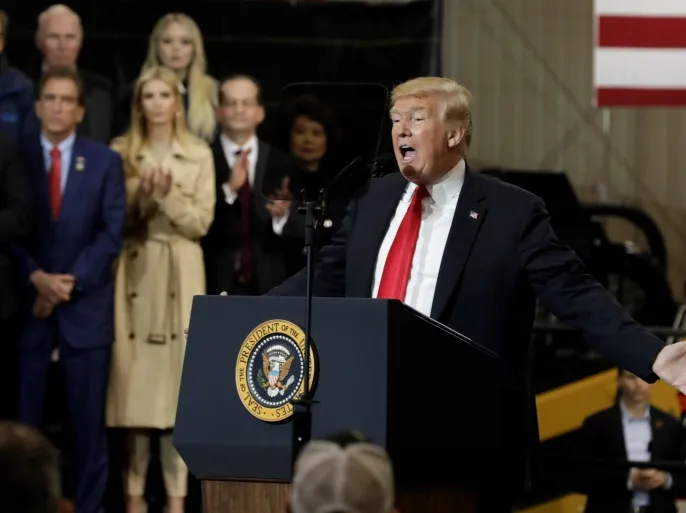
Today, we may be prompted to question the mechanism by which President Trump’s administration determines the United States’ global strategy, amid growing dynamics in international politics. There is a sharp and unstable stance in the statement of relations with Russia and China, and perhaps the most sensitive issues related to these two countries are North Korea and the taming of its regime to abandon its controversial nuclear program, as well as the case of Iran, where the regional security equation in the Middle East revolves around its cross-border role. If we take into account the existence of Israel and Saudi Arabia, which lead the Gulf to confront Iran’s expansion, the issue of a political settlement of the Middle East conflict between Israel and Palestine is not devoid of urgency for White House officials. Trump’s declaration that Jerusalem is Israel’s capital was made within a purely evaluative context, and in my opinion, the regional policy of the Middle East has been put to the procedural test regarding Jerusalem, which represents the chronic knot in the settlement issue, and I do not think there is a real formulation in Trump’s management box regarding the settlement of that issue, at least unless the United States can arrange international political rules and prepare them to secure a permanent and sustainable deal.
The intensification of the crisis in global strategic affairs is condemned in most of its instances to the excesses that the United States topped over the years following the Cold War, and what is more sorrowful is that an uncommitted president, lacking caution and precision, holds the reins of decision in the White House, and we must not accept the idea that America first, a strategy can be universalized.

Comments (0)
No comments yet. Be the first to comment.