 Aljazeera
The Lost Control and the Pitfalls of Military Options in the Korean Peninsula
The U.S. bet on China's ability to persuade its ally North Korea to abandon its alarming weapons programs failed, and Washington believed that Russia's stance up to that point did not appear supportive.
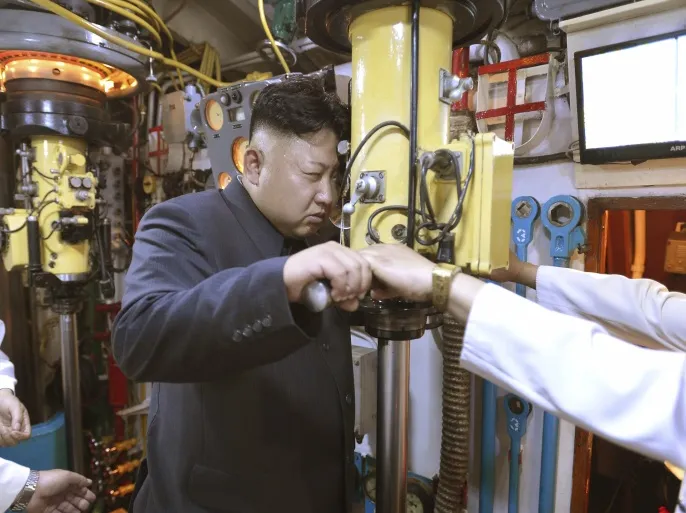
We have seen the United States, over the past two decades, establish an international alliance and rally its allies and friends to regain confidence in itself, when it waged two wars in Afghanistan and Iraq, aiming to impose stability and maintain global security. However, this did not happen in any form; instead, the weight of disorder and lack of discipline in strategic calculations increased, resulting from the failure of military war policy at a time when military power was no longer the sole principle for controlling the rules of the international game.
| The American bet on China’s ability to persuade its friend North Korea to abandon its alarming armament projects failed, and Washington believed that Russia’s position at the moment does not seem supportive. |
There is a fundamental reason that forces a comprehensive reassessment of security necessities that acquire a pivotal role in the framework of international relations, and in shaping the strategic mindset of the great powers. When the situation is linked to reciprocal security issues, caution becomes the master of the situation, as each party evaluates the degree of threats it faces based on the adversary’s capabilities, thereby preparing all parties to deal with the worst-case scenario. We have sufficient historical experiences to understand this context if we go back to the analysis of national policy during the First and Second World Wars and the Cold War, which erupted due to contradictions in the balance of powers, and whose dynamics were generated from the existing polarizations at that time, where the international players did not have the opportunity to formulate a compromise between diplomatic options and military strategies.
Therefore, the dilemma is not only about control but also about response, and the ability to take initiative in a climate dominated by urgent crises, which concerns the highest priority options for nations. However, the greatest weaknesses that mar this stance are primarily its focus on prudent estimates for decision-makers, which are ideal estimates that rarely materialize.
We have presented the above introduction in order to formulate terms that can lead to logical assessments of the current stance in the security environment of East Asia, which is considered the most dynamic region in the global economy, and what that means for Washington, with the presence of powerful forces such as China and Japan, and their influence on global strategic policies. If we can understand this context, we will recognize the reality of American anxieties about the growing problem of North Korea in that highly sensitive region.
We cannot, in any case, balance the strategic and tactical capabilities of the two sides of that dilemma, nor are we about to compare what North Korea can do against the vast arsenal of the United States. However, matters are not always measured in that way, if it enters the crisis line with strong links to determining future scenarios for a post-war era.
In recent weeks, the Trump administration gave the green light to carry out military strikes in Syria in response to the Syrian regime’s use of chemical weapons in the town of Khan Sheikhoun. Hopes rose for a qualitative change in Trump’s view of Syria, but this does not necessarily lead to optimism that the war in Syria will end soon. The purpose of this move was a strategic warning to the regimes that revolve around the global political equation, stating that the United States has moved beyond the policy of strategic patience in favor of demonstrating American composure first, which ultimately means that America cannot test its strength and its actions cannot be predicted.
Washington can say that the regime in North Korea does not care about the international community and does not want to assess its provocative behaviors toward the world, by proceeding with nuclear missile tests and threatening its neighbors South Korea and Japan, who are close allies of Washington and cannot abandon them. Washington can also emphasize that the sanctions regime against North Korea has not achieved the desired logical result, and that China, according to President Trump’s statements, does not have strong pressure papers on the North Korean regime.
Therefore, the prevailing saying in American political and strategic circles is that America failed to tame the North Korean regime and did not succeed in deterring its nuclear projects. Many of them advised President Trump to launch preemptive strikes against North Korean nuclear facilities, in an attempt to confirm the magnitude of the threat posed by the ruling regime there. Additionally, Americans have concerns stemming from North Korea’s attempt to invade the southern part and incorporate it under its banner, where North Korea’s nuclear option would serve as an effective deterrent to achieve that goal.
| We must not accept the idea that China could deliberately stand in the way of the United States to prevent it from moving militarily against North Korea, especially if Russia will withdraw itself from direct involvement. |
The American bet on China's ability to convince its friend North Korea to abandon its alarming arms projects has failed, and Washington believed that Russia's position at the time does not seem supportive, as Russia warned the Trump administration against resorting to unilateral military options against North Korea, because it would repeat extremely dangerous political mistakes.
China and Russia appear realistically frustrated despite holding several options, because the issue revolves around setting priorities. The problem in the Korean Peninsula does not lie in putting an end to the strategic challenges posed by the North's regime, even though they are seriously important, but what is reflected in the thinking of the Chinese and Russian leadership is the shape that North Korea will take if America slides into a war to eliminate the North's regime, and then attempts to formulate a new equation that does not take into account the underlying geo‑strategic concerns behind unifying the Korean Peninsula, which will inevitably represent a dangerous strategic choke point not only for China but also for Russia and Japan.
Simply put, we must not accept the idea that China could deliberately stand in the way of the United States to prevent it from moving militarily against North Korea, especially if Russia will withdraw itself from direct involvement, but that does not mean Washington should ignore serious avenues of understanding with these two great powers. In this context, information indicates that Moscow and Beijing have opened the door to Pyongyang and warned it of the dangers of continuing its confrontational policy.
It is not necessary to emphasize that a military scenario, in the American style, will not be able to topple a regime with a strange character, which has methods that allow it to remain in power despite severe difficulties it has faced for a long time. Of course, we must also point out the lack of accurate military assessments of the qualitative capabilities that North Korea possesses, which it will rely on to potentially respond violently against American alliances and interests. Thus, a swift and decisive defeat of the North's regime will not be easily secured, and the difficulty of achieving that goal could lead to a long period of turmoil, high costs of violence, and loss of security and stability.

Comments (0)
No comments yet. Be the first to comment.