 Aljazeera
China and the War for Existence: A Look at the Engines of Hegemony
Updates, announcements, and stories from Noah.
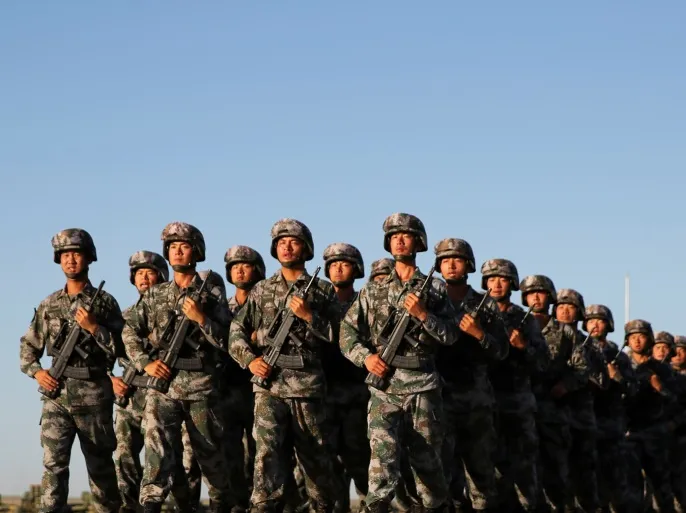
Understanding the current political doctrine – military or strategic – in China is a necessary element in evaluating the functional system of this state over the years following the Cold War, as the Chinese focused all their goals on a path of creating a huge qualitative leap through internal development and economic modernization in a way that opens new horizons for China to escape the shackles of the global axes and move toward strengthening the state's infrastructure, and then it will be easy for them later to open up to the external world.

Chinese people have a firm conviction that the structural variables left by the Cold War conflict contradict the idea of a single great power controlling the rules of the global game. The world has become, in the age of globalization and interdependence, and in light of the changing nature of power with new terms entering global strategic calculations, all under the reality of emerging global powers that possess the economic and technological capabilities that make them potential competitors to the United States. It is noted that the economic power of those countries could spark their desire to improve their military capabilities in the future in a way that does not attract attention, especially when they believe that strategic affairs must move toward pluralism.
The idea that this decisive shift has already occurred predicts an increase in structural imbalances in the international system, as a result of unilateral actions that America has taken over the past two decades, especially in light of the rise of American militarism after the liberation of Kuwait in 1991 and the invasions of Afghanistan in 2001 and Iraq in 2003. The Chinese, along with the Russians, share the same view that Washington adopts a policy of decisive pivoting to balance global strategic equilibrium, which has led them to surpass international institutions in an unethical manner.
Political theories assume that the leading state’s engagement in negative roles in the international system will make crisis management and conflict avoidance more difficult and less likely if other equally ambitious countries have the capacity to take an active role in managing world affairs in the future. According to this assumption, the current Chinese approach, relying on employing geopolitics as a primary driver of strategic conflict in wars of control and influence, and given the significant economic weight that is hard to ignore and considered a difficult number in the global balance of power equation, it is noteworthy that China has achieved significant advantages in the global economic structure, and then solidified its economic credibility due to the 2008 financial crisis, which weakened the central performance of the American economy.

At that time, China became one of the rescue elements for the U.S. government to avoid a general collapse. The Chinese benefited from this crisis by raising the efficiency of their national economies and then floating the Chinese economy in global markets in an attempt to establish a strong integrative relationship, helping China acquire large shares of investments and commercial exchanges. This is part of efforts to control the top of the global economic pyramid. Since the beginning of this decade, the Chinese economy has been second worldwide after the United States, and according to strategic estimates related to the assessment of the Chinese economy’s movement, it is possible for the Chinese economy to surpass the American economy in the next decade if the Chinese government continues to improve the health and stability of its economy.
The strategic assessment of China’s economic model is an evaluation of the integrated revolution within it, which intersects with the political path in a syndromic way, and the path of this revolution with its sprawling dimensions is the hardest issue raised for discussion in American political and strategic circles.
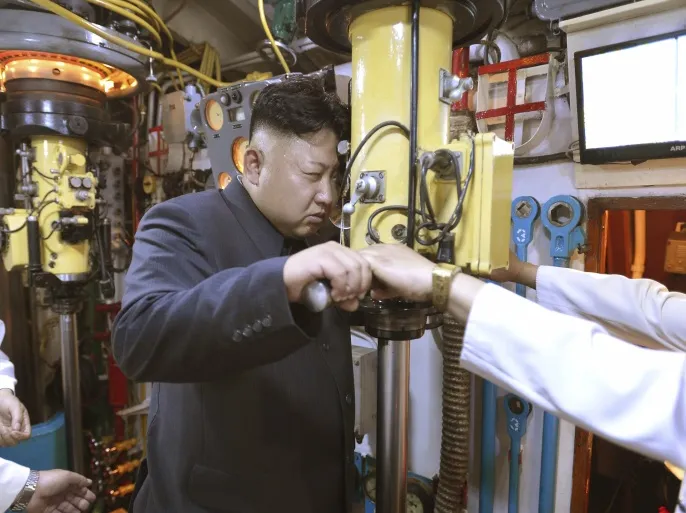
Perhaps what makes China a highly sensitive issue for Americans is the current interaction in the context of the nuclear crisis with North Korea, because China’s presence constitutes a fundamental axis within U.S. strategic calculations regarding containing the North Korean regime, which in turn does not yet care about international demands to halt its nuclear ambitions and sit at the negotiation table.

What matters to us in this context is the Chinese perspective on the reality of what is happening in international politics regarding the North Korean crisis, as the Korean Peninsula and East Asia have become a subject of precise scrutiny. There is a regime that does not accept pressure, does not recognize soft diplomacy, and does not engage with coercive diplomacy, which is a deep-impact problem in itself, regarding the multi‑party security and strategic complications in East Asia. Perhaps what concerns China most in this situation is the possibility of sliding into the concept of “covert deterrence,” and China may also have concerns if the United States establishes new rules that do not accommodate the geo‑strategic and geopolitical necessities for China in particular.
There is no doubt that what China urgently wants lies in successfully pursuing the diplomatic path to block Washington and undermine its strategic military planning in East Asia. Some Chinese political institutionists see that a regime armed with a nuclear arsenal in North Korea can serve as a bargaining paper in shaping the rules of the game in all of Asia, and this depends on China’s ability to provide consistent data to bring together Korean and American perspectives to exit the crisis with minimal harmful side effects for regional security.
China’s equation, especially to a large extent, is that it cannot bargain over its vital interests, and perhaps more than that lies in preserving the extraordinary gains achieved through a long and hard path of development and modernization. It recognizes that the appropriate intersection of politics, economics, technology, and military stature will necessarily serve the limitless confidence of China regarding its capabilities and regional influence. Strategic decision makers in China should understand that the rise or disappearance of a great power in the world requires engagement in a devastating world war or a vast cosmic conflict, and it is unreasonable for China to be ready for that possibility.

Comments (0)
No comments yet. Be the first to comment.